Season 1 — Fate Chart and Soul Hunt
Season 1 is called Soul Hunt, it runs on a narrative device called the Fate Chart, and its headline mechanic — Soul Harvest — was deliberately held back to roll out after launch rather than shipping with it. Here is what the developers have actually confirmed, and what they are still keeping quiet.

What the season is
Season 1 is named Soul Hunt, and its organising idea is the Fate Chart — a narrative device the developers describe as driving the entire seasonal main storyline. The in-game Season screen, visible in the developers’ own screenshots, renders the S1 heading as “Soul Hunting” and places the Fate Chart as the first tab, alongside Path of Glory, Leaderboard and Season Reset.
The story it tells: the Valgr have restarted forbidden soul experiments, turning countless creatures into Cocoon Puppets in an attempt to wield soul power, create a False God and tear apart the Web of Fate. Dew calls on Gyldhunters to track down wandering exiled souls and contain the spread of soul corruption. The developers say every player’s actions feed back into the Fate Chart and reshape the direction shown on it.
What the Fate Chart does, beyond the story
Bellring Games have described the Fate Chart’s role in the narrative and little else, so everything in this section comes from players and community databases rather than from the developers. Treat it accordingly.
The Fate Chart runs as a time-limited event inside the Season tab, which is why the tab can look empty: if the current chart has not started or has already closed, there is nothing there to progress, and the season’s other tracks carry on regardless.
While it is running it has its own currency, Echo of Fate, described in game as “an echo coalesced from the Fate Chart”. You earn it from repeatable quests and spend it in the Fate Chart shop. Those repeatable quests are a separate track from the story line — the 128 quests of the story track are listed separately, and where any of them publishes a reward at all it is gold or an item rather than a seasonal currency. Players report a weekly cap of 3,000, which is reported to be exactly the cost of the Pro Combat Bag and the Advanced Combat Bag together — so the practical advice going round is to spend the cap each week rather than bank it.
Two things follow from that, and both cost you something if you get them wrong:
- Do not hoard it across a season boundary. Community currency lists put Echo of Fate among the balances that are wiped at season rollover, so a stack saved for “next season” is a stack thrown away.
- A blocked upgrade may not be a bug. If an upgrade refuses with a Fate Chart message, that is the chart gating it by design for this stage of the season, not something to be worked around.
None of the above is in a patch note. The narrative role of the Fate Chart is first-party and quotable; the numbers, the cap and the wipe list are player and database reports, and are the sort of thing a season update can change without anybody announcing it.
Soul Harvest, and why it was not there at launch
Soul Harvest is the seasonal gameplay feature that connects the narrative to what you actually do in a match. It did not ship on day one — the developers were explicit that it would “roll out progressively after the official launch,” having earlier said it would arrive a few weeks after open beta.
What they have confirmed about it is narrow but specific. In matches where the Soul Harvest ritual is active, a new elite monster appears: the Soulgnawer. She actively disrupts the ritual while it runs, and you have to defeat her to complete it. While that is happening you also have to watch for rival Gyldhunters — the developers point out that a ritual is exactly the kind of fixed, noisy objective a third party will ambush.
The exact mechanics and gameplay loops are being deliberately withheld. The developers said so twice, in two separate updates.
The Soulgnawer is worth keeping as a reference point, because it is what a documented monster looks like on this game: a name, a description the developers wrote themselves, and a concept sheet published alongside it. Very little else players meet in the mist has all three. The creature they call the bird lady has none of them.
The battle pass is genuinely free
The Season 1 Battle Pass is called Slumbering Contract, and it unlocks for free after seven days of cumulative logins — cumulative, not consecutive.
The more consequential part is the renewal rule. The developers stated that as long as you maintain a certain level of activity during a season, you will be able to renew and unlock the next season’s battle pass for free as well. In other words the pass is not free once as a launch promotion; it is designed to stay free for players who keep playing.
The Slumbering Servant outfit, which drew attention during Steam Next Fest, was added to the battle pass rewards and is redeemable with tokens earned through ordinary play.
What shipped with the season
The launch version’s content list, as published by the developers:
- The Withered Knight’s Polearm & Shield weapon — see the Withered Knight guide
- Holy weapons and their exclusive gameplay affixes — see gear
- Brandrgarde on Cataclysm difficulty
- Season 1 “Soul Hunt” plus seasonal tasks and events
- The Soul Harvest seasonal gameplay
- Collection Pedestal, for displaying loot in camp
- The Ladder & Tier Reward system — see Path of Glory
- More cosmetics, and the free battle pass
One item was cut from that list for development-timeline reasons: the Blackarrow’s second weapon, which is now expected in a future season.
Mid-season: the Ancestor Tree
Announced for the Season 1 mid-season update and exclusive to Hallowgrove, the Ancestor Tree spawns on the map over time and works as a contest point beyond the traditional high-tier resource nodes. The developers framed the decision it creates in the same terms as the rest of the game: go for the treasure, or play it safe and cash out.
How long it lasts
A season is currently expected to run three to four months. Seasonal resets do happen — the developers confirmed that directly — though they said certain long-term progression elements carry over rather than everything being wiped.
For what comes after, they have committed to publishing a new roadmap toward the end of each season, and to synchronising all patch notes and their specific details to Discord alongside the in-game notifications.
The Soulgnawer
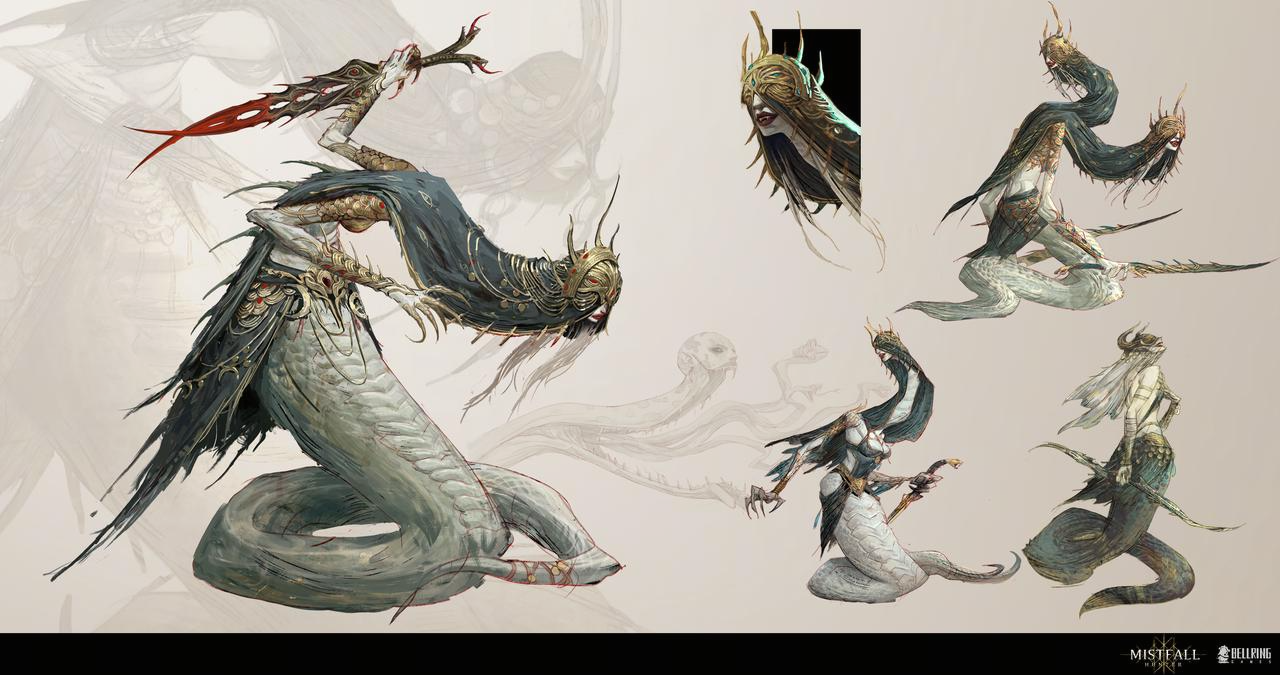
The Soulgnawer, the elite monster that disrupts the Soul Harvest ritual. Concept sheet from Developer Update #7 — it matches the developers' description of a slender build, a serpentine lower body and human-like facial features.
Concept art published by Bellring Games in Developer Update #7, 24 July 2026.
Frequently asked questions
What is Season 1 in Mistfall Hunter called?
Soul Hunt. The in-game Season screen renders the S1 title as "Soul Hunting". Its core narrative concept is the Fate Chart, and the whole season's main storyline unfolds around it.
What is Soul Harvest in Mistfall Hunter?
The core seasonal gameplay feature tying the Season 1 storyline together. It did not ship at launch — the developers said it would roll out progressively afterwards. In matches where the ritual is active you must defeat an elite monster called the Soulgnawer to complete it.
What is the Soulgnawer?
A new elite monster introduced with Soul Harvest, described by the developers as having a slender build, a serpentine lower body and human-like facial features. She actively disrupts the ritual, and you have to defeat her to finish it.
Is the Mistfall Hunter Season 1 battle pass free?
Yes. The Season 1 Battle Pass, "Slumbering Contract", unlocks for free after seven days of cumulative logins. The developers also said that maintaining a certain level of activity during a season lets you renew the next season's pass for free.
How long is a season in Mistfall Hunter?
Three to four months, per the developers' answer in the community AMA. Seasonal resets do happen, though certain long-term progression elements carry over.
What is the Ancestor Tree in Mistfall Hunter?
A Hallowgrove-exclusive feature announced for the Season 1 mid-season update. The developers said it spawns on the map over time and functions as a high-value contest point — go for the treasure or cash out safely.